A-Levels Curriculum Overview
At Gateacre Sixth Form, our A-Levels programme offers a broad and academically rigorous pathway that prepares students for success in higher education, apprenticeships and future careers. Our extensive suite of A-Level subjects allows learners to pursue their passions and strengths while developing essential skills in critical thinking, independent study, research and communication. From traditional academic subjects such as Biology, Mathematics, English and History, to creative and technical options like Media, Art and Computer Science, each course is designed to stretch students’ abilities and develop deep subject knowledge.
Students benefit from personalised support, enrichment opportunities and high-quality teaching, enabling them to achieve excellent results and progress confidently to university or the world of work. Gateacre’s A-Level curriculum is enriched by real-world links, careers guidance and optional activities that build cultural capital and employability skills, ensuring a well-rounded post-16 experience.



Art
A-Level Art and Design (EDUQAS board)
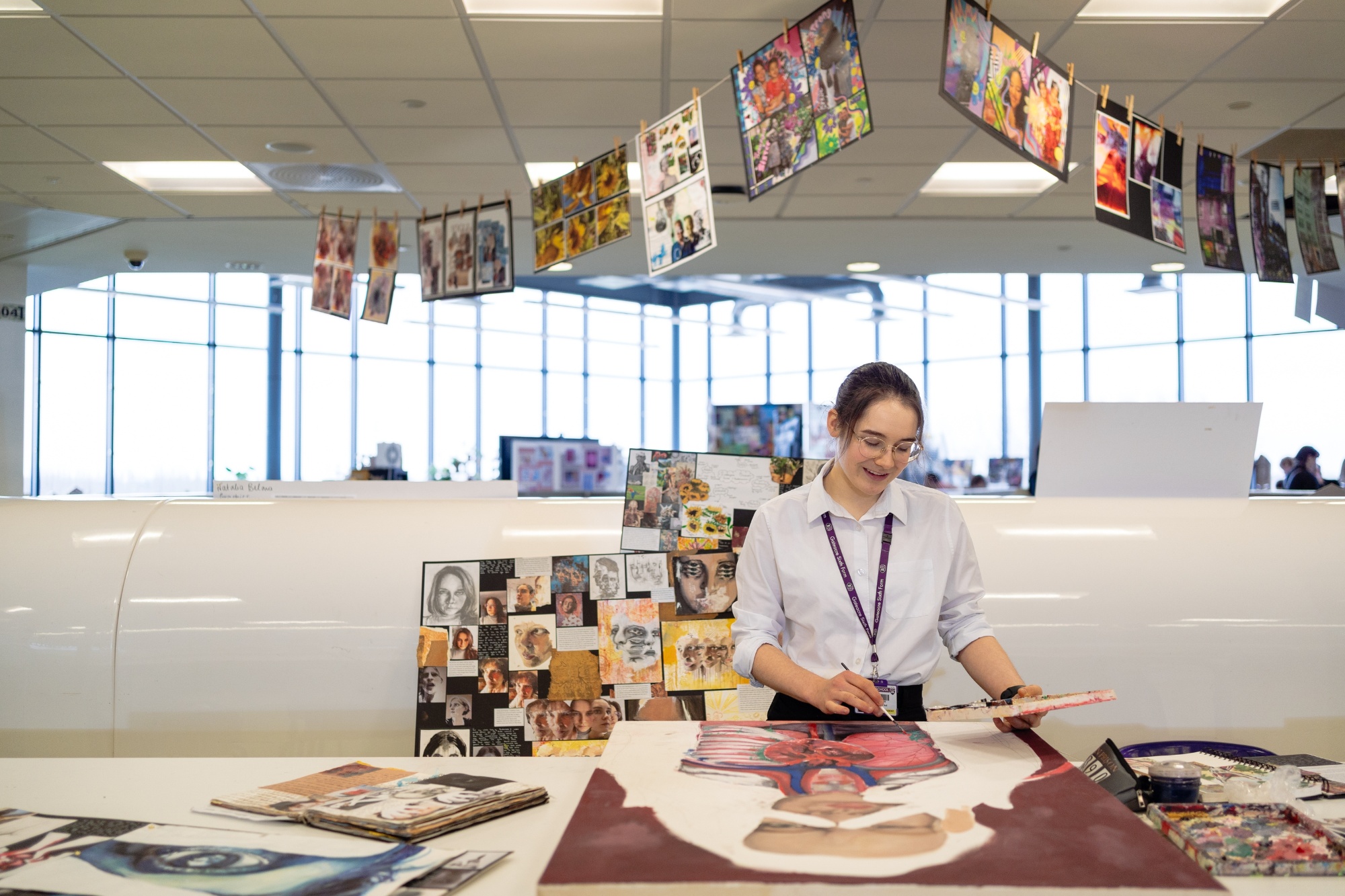
Over this two-year course, pupils are supported on a visual and creative journey that focusses on the learner’s personal progress. Students are encouraged to explore and experiment across a broad range of materials, developing personal ideas along the way. Students opting for A-level Art will be expected to have completed GCSE Art and/or GCSE Graphic Design.
Art and Design
This creative and exciting course involves pupils developing new practical skills. These will include drawing and painting, photography, graphics, mixed media, digital art, and art textiles and ceramics.
The course is a chance to explore and visually promote your own style and skills. You’re given creative freedom to approach tasks in a personal way and develop your individual strengths to produce outcomes. If you have any queries about the course, please come and ask the art staff or current art artists, who will be happy to help.
Course Details
The full A-Level qualification is made up of:
Unit 1 60% – Coursework portfolio, 1 very personal project (y12-13).
Plus a written study (1000 – 3000 words).
Unit 2 40% – Controlled Assignment: 15 hour exam, plus prep work.
Possible Careers
- Contemporary artist
- Graphic design
- Magazine publisher
- Animation/Illustration/Advertisement
- Fashion and textile design/Promotion/Buyer
- Jewellery/3D design/Stage set design
- Teacher
- Architect
- Curator
- Art historian
- Art therapist
Careers in the creative sector are among the fastest-growing in the UK. The creative industry provides around 2 million jobs and is growing at double the rate of the economy as a whole. Come and start your artistic path to the future.
In the art department, we pride ourselves on the excellent exam results we achieve year after year. We have established a record of success in Art, with 100% A-C results maintained over several years.
Applied Business
The AQA Level 3 Certificate in Applied Business will give students the opportunity to learn and understand the fundamental business and entrepreneurial knowledge and skills associated with working within a business enterprise.
Students will understand the way in which any venture in business (big or small) is a function of the relationship between its people, its marketing, its finance and its ability to deliver operationally upon its commitments.
Students will undertake a programme of assessment designed to assess not only their business knowledge and understanding, but also the way in which this knowledge and understanding can be applied to shape their practical skill in thinking and realising their own plans about business. For those who wish their learning to be practical and active, making use of their own business imagination, then the Certificate in Applied Business is a highly relevant qualification.
Year 12 culminates in Unit 3 Entrepreneurial Opportunities, which brings together key elements from units 1 and 2 into a practical, synoptic assessment of the learner’s readiness for entrepreneurial activity and opportunity. This practical unit can be used as the seed for further study in the Extended Certificate (via the Business proposal unit) or as the basis for the learner’s own initial business venture.
Year 13 is practical and hands-on where students get to apply their knowledge, organise an event and write a business plan. Both of these units are assessed through written coursework. The final unit is an exam which focusses on motivation, leadership and management.
A-Level Business is a practical course and in recent years students have had the opportunity to visit New York to learn about business in other countries. An exciting and practical course, a break down of the study programme is below.
| Unit | Unit Title | Assessment |
| 1 |
Financial planning and analysis |
External examination |
| 2 | Business dynamics | Internally centre assessed |
| 3 | Entrepreneurial opportunities (synoptic assessment unit) | External examination |
| 4 | Managing and leading people | External examination |
| 5 | Developing a business proposal (synoptic assessment unit) | Internally centre assessed |
| 6 | Managing an event | Internally centre assessed |
BIOLOGY
Biology is the science of life and how living things work.
Biology is a useful qualification for many courses and careers including Biomedical engineering, Nursing, Healthcare of people and animals, Optician, Environmental Health Sciences, Biotechnology, Physiologist, Natural Resource Management, Wildlife Biologist, Archaeology, Marine Biology, Forest management, Agricultural Industries, Anthropology, Teacher Training, Ecology, Fish Farming, Crop Management, Nutritionists and many more!
Entry requirements:
Learners will need to have at least a grade 6-6 in GCSE Combined Science; a strong footing in GCSE.
Mathematics is also recommended with a 6 grade being highly recommended.
The course followed will be the new AQA Biology GCE Advanced course which consists of AS studied in Year 12 and A2 in Year 13.
CHEMISTRY
Chemistry is essential for those going on to study the subject itself or any of the following: Biology, Biochemistry, Medicine, Dentistry, Pharmacy, Food Science or Chemical Engineering. It is strongly recommended for those interested in Earth Sciences such as Geology or Metallurgy.
Chemistry is a useful qualification for many courses and careers, including Psychology, Computer Studies, Accountancy and many more!
Entry requirements:
Learners will need to have at least a grade 6-6 in GCSE Combined Science; a strong footing in GCSE.
Mathematics is also recommended with a 6 grade being highly recommended.
The course followed will be the new AQA Chemistry GCE Advanced course, which consists of AS which is studied in Year 12 and A2 in Year 13.
CRIMINOLOGY
What is Criminology?
Criminology is an exciting and innovative new subject option here at Gateacre. Throughout the course you will explore different aspects of criminality and the criminal justice system, with a clear emphasis on the impact that crime has upon society. You will study issues such as victimisation and the legal process in the UK, as well as gaining a theoretical understanding of crime and deviance, giving you an insight into the reasons why people turn to crime and how this has real-world impacts on individuals and communities.
What will I study?
Unit 1: Changing awareness of crime
You will explore the different types of crime that people commit and the reasons behind those crimes. This unit will seek to dispel some of the myths and stereotypes surrounding crime, giving you a more accurate picture of the complexities surrounding the nature and extent of crime in society today. When it comes to public and social policy, lawmakers and politicians often turn to the academic community to provide them with the evidence and theoretical justification for their solutions to problems in society.
Unit 2: Criminological theories
This will provide insight into the theory of criminality and give you the opportunity to critically examine these explanations by challenging existing beliefs.
Unit 3: Crime scene to courtroom
This will take you on a journey from when a crime is initially detected, through to the verdict in a courtroom.
Unit 4: Crime scene and punishment
You will explore the societal mechanisms, processes, institutions and agencies that are involved in either preventing crime in the first instance or how society deals with offenders once a crime has occurred.
Assessment
This qualification is a Level 3 Applied Diploma using the WJEC specification. It is the equivalent of an A-level, so for example achieving an A grade in Criminology will give you 48 UCAS tariff points, just like any other A-level. Over the two year course, you will be assessed using internal controlled assessments as well as external exams. Each of the units gives equal weight to your final overall result.
| Unit | Unit Title | Assessment | % of Qualification |
| 1 |
Changing awareness of crime |
Controlled |
25 |
| 2 | Criminological theories | Exam |
25 |
| 3 | Crime scene to courtroom | Controlled | 25 |
| 4 | Crime scene and punishment | Exam | 25 |
DRAMA AND THEATRE
Why choose this course?
Drama and Theatre can open many doors to many different careers. This is an academic A-Level and therefore it has currency for a range of degrees. Universities recognise the value of this subject as it develops skills that can be applied to most areas of study: team work, communication and presentation skills, self motivation and responsibility, time management, analytical skills, confidence and high levels of creativity.
There is a strong practical element to the course with options for students interested in Art, Design, Media or Music to hone their skills through developing specialisms in costume, set, sound, lighting, etc. Alongside this, the theoretical aspects of the course allow students to develop their analytical skills and written communication. Students who study Drama, therefore, can also often go on to be accepted onto wider ranging degree courses such as Medicine, Law, English and Business.
Further Information:
- It is recommended that candidates who wish to pursue this A-Level have a grade 4 or above in GCSE Drama.
- You will be welcomed into a vibrant and busy department with state-of-the-art facilities. We will also use our industry links to organise supportive practical workshops run by a range of professional actors, directors and theatre companies.
- You will be able to attend several theatre visits a year at different locations across the UK and a residential trip.
- You will also have the opportunity to participate in a wide range of extra curricular events such as theatre in education projects, showcases, school productions, external projects and parades, etc.
- You will be taught by teachers who have industry experience and who pride themselves on a 100% A*-B pass rate for all practical performances.
ENGLISH LANGUAGE
English Language is one of the most popular and successful A level subjects at Gateacre. It covers many aspects of language including how children learn language, how language is structured, how we recognise varieties of English, how language operates within society and how language changes over time.
Pupils are also given the opportunity to practise their own writing for different audiences and purposes, and are expected to conduct their own research and report on it. The ‘A’ level is accepted by all universities and would be of direct interest to most Arts students.
Candidates would be expected to have an interest in language and to have shown enthusiasm for creative writing.
Paper 1: Language, the individual and society
Written exam: 2 hours 30 minutes; 100 marks; 40% of A-level
What's assessed?
Textual variations and representations
Children's language development (0 – 11 years)
Methods of language analysis are integrated into the activities
Section A – Textual variations and representations:
- Two texts (one contemporary and one older text) linked by topic or theme.
- A question requiring analysis of one text
- A question requiring analysis of a second text
- A question requiring comparison of the two texts
Section B – Children's language development:
- A discursive essay on children’s language development, with a choice of two questions where the data provided will focus on spoken, written or multimodal language.
Paper 2: Language diversity and change
Written exam: 2 hours 30 minutes; 100 marks; 40% of A-level
What's assessed?
Language diversity and change; language discourses; writing skills (methods of language analysis are integrated into the activities)
Section A – Diversity and change
One question from a choice of two:
either: an evaluative essay on language diversity
or: an evaluative essay on language change
Section B – Language discourses
Two texts about a topic linked to the study of diversity and change.
- A question requiring analysis of how the texts use language to present ideas, attitudes and opinions
- A directed writing task linked to the same topic and the ideas in the texts
Non-exam assessment (coursework): Language in action
Word count: 3,500; 20% of A-level assessed by teachers moderated by AQA
What's assessed?
- Language investigation
- Original writing
- Methods of language analysis are integrated into the activities
- Tasks
Students produce:
- A language investigation (2,000 words excluding data)
- A piece of original writing and commentary (1,500 words total)
Entry requirements:
GCSE Grade 5 or above in Language or Literature
English Language
Entry requirements: GCSE Grade 5 or above in Language or Literature
English Language is one of the most popular and successful A-Level subjects at Gateacre. It covers many aspects of language including how children learn language, how language is structured, how we recognise varieties of English, how language operates within society and how language changes over time. Pupils are also given the opportunity to practise their own writing for different audiences and purposes, and are expected to conduct their own research and report on it. The ‘A’ level is accepted by all universities and would be of direct interest to most Arts students. Candidates would be expected to have an interest in language and to have shown enthusiasm for creative writing.
Paper 1: Language, the individual and society
Written exam: 2 hours 30 minutes; 100 marks; 40% of A-level
What's assessed?
- Textual variations and representations
- Children's language development (0 – 11 years)
- Methods of language analysis are integrated into the activities
Section A – Textual variations and representations
Two texts (one contemporary and one older text) linked by topic or theme.
- A question requiring analysis of one text
- A question requiring analysis of a second text
- A question requiring comparison of the two texts
Section B – Children's language development
- A discursive essay on children’s language development, with a choice of two questions where the data provided will focus on spoken, written or multimodal language.
Paper 2: Language diversity and change
Written exam: 2 hours 30 minutes; 100 marks; 40% of A-level
What's assessed?
Language diversity and change; language discourses; writing skills (methods of language analysis are integrated into the activities)
Section A – Diversity and change
One question from a choice of two:
either: an evaluative essay on language diversity
or: an evaluative essay on language change
Section B – Language discourses
Two texts about a topic linked to the study of diversity and change.
- Question requiring analysis of how the texts use language to present ideas, attitudes and opinions
- A directed writing task linked to the same topic and the ideas in the texts
Non-exam assessment (coursework): Language in action
Word count: 3,500; 20% of A-level assessed by teachers moderated by AQA
What's assessed?
Language investigation
- Original writing
- Methods of language analysis are integrated into the activities
- Tasks
Students produce:
- A language investigation (2,000 words excluding data)
- A piece of original writing and commentary (1,500 words total)
ENGLISH LITERATURE
Entry requirements: GCSE Grade 5 or above in English Language or English Literature
English Literature is one of the most popular and successful A level subjects at Gateacre. Students study a variety of literary periods and genres and are introduced to the conventions of literary study and critical thinking. The course also focusses on the social, historical and cultural contexts in which literary texts are written and understood. Candidates must have an interest in Literature and enjoy reading. Enthusiasm for writing is also advantageous.
Assessment
Component 1
Poetry
Written examination – 2 hours - 30% of qualification
Section A - Poetry pre-1900 (open-book, clean copy)
One two-part question based on the reading of one pre-1900 poetry text from a prescribed list (The Miller’s Tale, Chaucer)
Section B - Poetry post-1900 (open-book, clean copy)
One question from a choice of two based on the reading of two post-1900 poetry texts from a prescribed list (Carol Anne Duffy Mean Time & Philip Larkin The Whitsun Weddings)
Component 2
Drama
Written examination – 2 hours - 30% of qualification
Section A - Shakespeare (closed book)
One two-part question based on the reading of one Shakespeare play from a prescribed list (King Lear)
Section B - Drama (closed book)
One question from a choice of two based on the reading of a pair of plays: onepre-1900 and one post-1900, from a prescribed list
(Tennessee Williams A Street Car named Desire & John Webster, The Duchess of Malfi)
Component 3
Unseen Texts
Written examination – 2 hours - 20% of qualification
Section A - Unseen prose
One question from a choice of two, analysing an unseen passage of prose, taken from one of two
prescribed periods for study
Section B - Unseen poetry
One question from a choice of two, analysing an unseen poem or poetry extract
Component 4
Prose study
Non-exam assessment - 20% of qualification
One 2500 - 3500 word assignment based on the reading of two prose texts from different periods, one
pre-2000 (Remains of the Day, Kazuo Ishiguro) and one post-2000 (Atonement, Ian McEwan).
EPQ
Students are given the chance to complete an extra qualification called the Extended Project Qualification, its a bit like a mini thesis. It provides an opportunity for students to extend their abilities beyond their sixth form course of study, stand out and prepare for university or their future career.
Students pick their own topic or investigations with support from their EPQ supervisor and some of our students past project titles can be found below:
"Should unfitness to plead be a mechanism in the criminal justice system?"
"What impact has covid had on children of primary school age?"
"Will developments in Artificial Intelligence have a positive or negative impact on employment in the UK?"
"Could we adapt Japan's smart space efficient buildings to something that would work in the western world?"
Further Mathematics
Why should I choose further Mathematics?
Students who are thinking of reading Mathematics, Computer Science, Engineering or a related subject degree (STEM subjects) are strongly advised to take Further Mathematics at A Level as are candidates considering entry to the universities of Oxford and Cambridge to study a scientific/engineering discipline.
What does the course involve?
Students follow the Edexcel GCE Mathematics and Further Mathematics A Level specifications. The compulsory topics for Further Mathematics are: Proof, Complex Numbers, Matrices, Further Algebra and Functions, Further Calculus, Further Vectors, Polar Coordinates, Hyperbolic Functions and Differential Equations.
What skills will I develop?
Maths allows you to hone your ability to solve mathematical problems as well as abstract and scientific ones too. These problem-solving skills can then be applied to many different areas of your life. You’ll also learn how to analyse patterns, structures and problems, which will in turn, help you to develop a critical eye. This will come in handy in both further study and future careers. Maths at A Level will leave you with research skills that will allow you to find solutions to problems, investigate theories, and therefore give you the ability to find new information more effectively. Finally, your logical abilities will be developed so that you will have tools needed to tackle a number of diverse areas, from managing your finances to planning projects.
How will I be assessed?
4 × 1 hour 30 minute examinations:
2 Compulsory Pure
2 Optional Units
Entry requirements
To successfully study Further Maths A level students will need a grade 8 or a grade 9 at GCSE.
History
Why choose History?
History gives us a better understanding of the world we live in. It is a subject that helps develop analytical skills, communication skills and research skills. You will develop valuable life skills, such as analysis, evaluation and discussion. History is highly regarded by employers and universities. The History Department at Gateacre School has a proud record of academic achievement.
What do our students say about A-level History?
With A-level history there is always something that you will find interesting no matter the topic and the teachers are amazing; they'll make sure you understand everything you need to and just make the whole experience better.
Regan, Year 13 student, 2021.
"A Level History is not only interesting, but I have found that the skills I have learnt and improved on has helped me in other subjects and has set me up with skills that are going to be useful for Uni. The topics are definitely interesting, and you will be sure to enjoy History."
Taylor, Year 13 student, 2021.
How can History help a students career?
There are so many careers out there that require the skills that studying history develops.
These include: Law; Journalism; Research; Politics; Business, Finance and accountancy; and many more!
INFORMATION TECHNOLOGY
What does the qualification cover?
Cambridge Technical in IT L3 (equivalent to one A-Level)
This course provides excellent preparation for higher study and employment in the field of Information Technology. The increasing importance of Information Technologies means there will be a growing demand for professionals who are qualified in this area.
Unit 1: Fundamentals of IT
A sound understanding of IT technologies and practices is essential for IT professionals. Information learnt in this unit will create a solid foundation in the fundamentals of hardware, networks, software, the ethical use of computers and how businesses use IT.
Unit 2: Global Information
This unit will provide students with a greater understanding of how organisations use information sources both internally and externally and the types of information they will encounter.
Unit 5: Virtual and Augmented Reality
Virtual Reality is a simulated environment that is intended to replicate the physical experience of being in places in the real or imagined worlds, by giving the user sensory experiences that match those which would be experienced were the user actually in that environment. Augmented Reality is the process of changing the user’s view of the real world in order to give them an improved, or more detailed view of what they are seeing. This unit supports the development of skills, knowledge and understanding relevant to a job role in the areas of 3D modelling, digital transformation and even the film and games industry.
Unit 13: Social Media and Digital Marketing
The use of social media has increased massively over recent years and is now a world-wide phenomenon. This unit looks at social media and digital marketing as a concept and offers students the opportunity to explore the possible impacts, both positive and negative, that may be generated by the use of social media as a digital marketing tool.
Unit 17: Internet of Everything (IOE)
Internet of Everything (IOE) This unit is about the use of the Internet and how it is impacting people and society. You will learn about smart devices and how they are developed e.g. Alexa, smart apps, smart bulbs, smart cameras, smart CCTV, smart watches, smart lights, smart tv etc. You will design your own smart product as well.
All learners are supported by the following:
- After school clubs available and online tracking so students can continually monitor their own progress
- 6 purpose built I.T. suites and 2 I.T. pods, all equipped with 30 brand new computers and new computing equipment such as, VR headsets, laptops and headsets etc.
- The latest industry standard software including MS Office 365, Adobe software suite and VR/AR/MR App development software e.g. XR+ (Virtual Reality/Augmented Reality/Mixed Reality)
- Student also have access to Microsoft Office 365, which includes all Microsoft software and their own One Drive account (online cloud storage) so they can access their files from home, complete their work online and upload assignments
If you would like an interesting, interactive and engaging choice of topics, then this course is for you.
Mathematics
Why take Maths A level?
Maths is one of the most desirable and challenging A levels. The skills that the course requires and develops in both numeracy and problem solving are always highly desirable by employers both in industry and further educational institutes.
Maths A level is an excellent gateway qualification leading into a range of sectors such as finance, business, ICT, economics, psychology and engineering. It is a mark of academic distinction and highly respected in further education.
In a 2016 study by Nottingham University, it was also found that “students that had successfully studied A level Maths received an average of an 11% increase in salary by the time they reached 34. No other A level attracted such a sustained and steady wage premium.”
Maths A level continues and develops concepts begun at GCSE and starts to really allow students to appreciate their importance and application in understanding the world around us, offering students the keys to the Universe.
Requirements for the Course:
To study A level Maths, it is crucial that the student has studied towards the higher paper at GCSE.
It is preferable for the student to have achieved at least a grade 7.
The Course:
The A level Maths course covers three main areas:
Pure Maths:
In Year 12 Pure Maths develops a lot of the topics covered in the final stages of the GCSE, but in more depth. We look at a lot of the higher algebra techniques, circles, quadratic graphs and trigonometry in more detail. This allows a more general understanding of why these topics offer so much understanding of the world around us and how they can be applied to problems in a range of contexts. We also begin to look at Calculus (differentiation and integration) and why this has become such a fundamental part of how we understand so much about our world and its inner workings since its discovery by Newton and Leibniz in the 17th century. We also introduce exponentials and logarithms and investigate their application to subjects such as population growth and radioactive decay.
Statistics:
Statistics is the study of data and probability. It is one of the most widely used part of Maths in the real world and understanding its intricacies is an interesting and important skill sought after by employers. We start by again recapping a lot of the work done towards the end of the GCSE and develop more depth to students understanding of topics such as averages, charts & diagrams, bivariate data and probability. We also start to look at statistical modelling and hypothesis testing.
Mechanics:
Mechanics is the study of motion. Why do things move the way they do, and can we predict their movement if we know certain things about them? It is the precursor to Rocket Science! “Rocket Science is just Newtonian mechanics with variable mass.” It builds on some of the ideas started in GCSE Maths such as speed distance and time, however it is the newest part of the syllabus. Students always love mechanics as it is the study of the real world. A lot of the ideas and models introduced are common sense once explained and their applications are everywhere around us.
In Year 13 a lot of the topics covered in Year 12 are built upon, developed and linked together. This allows students to broaden their understanding of Mathematics and truly start to appreciate it as a web of concepts, all interwoven and affecting each other in myriad ways and not just a list of separate skills done one after the other.
Exams:
The AQA A level has 3 exams, all 2 hours long and each worth 100 marks. Paper 1 is all pure topics, paper 2 is mechanics and pure and paper 3 is statistics and pure.
If you are genuinely interested in a degree and career in mathematics, engineering or physics, it is worth considering choosing A-level Further Maths. Information about this A-level can be obtained from the maths department.
Media Studies
What are Media Studies?
Media Studies A- Level is the critical examination of media products, e.g. Film, TV and print, and the way in which we interact with them. Many different media industries are studied, such as film, magazine, music videos, computer games, radio and TV texts. Students are also expected to develop and create their own products using the skills and ideas they have acquired.
Why should I take Media Studies?
The Media industries are one of the fastest growing employment sectors in the North West and students have a number of progression opportunities following their Level 3 studies. Students who have completed an A-Level course in media Studies have gone on to a variety of exciting study and employment opportunities, including journalism, film and TV work and developing digital content for online businesses.
What will the course entail?
We offer the EDUQAS revised curriculum. The new examination format is an exciting and rigorous course designed to introduce students to the critical and theoretical understanding of media products from a range of historical and cultural contexts. The course also offers students the opportunity to develop their own creative and practical production skills in the planning, production and presentation of media texts. Photography and graphic design skills are developed across this aspect of the course as students are given a brief to create a film/ games marketing campaign or a selection of magazine pages and they will use Photoshop to create professional standard products.
The A-Level course is a unitised qualification:
| Unit | Unit Title | Assessment | % of Qualification |
| 1 |
Media, Industries and Audiences |
Exam |
35 |
| 2 | Media Products and forms of depth | Exam |
35 |
| 3 | Cross - Media Production | Coursework | 30 |
Music
The A-Level music course may be seen as a continuation of G.C.S.E. Music in that it is based on three key components: listening/appraising, performing and composing.
COMPONENT 1: APPRAISING (listening, analysis and understanding) 40% of total A-Level marks
An exam paper in three sections (A: Listening, B: Analysis and C: Essay) based on three Areas of Study:
The Western Classical Tradition 1650-1910
Including the Baroque solo concerto, Mozart’s operas and the piano music of the Romantic period
Music for Theatre or Media
Including music by Stephen Sondheim, Claude-Michel Schonberg and Jason Robert Brown or Bernard Herrman and Hans Zimmer.
Popular Music
Including Stevie Wonder, Joni Mitchell, Muse, Beyonce, Daft Punk and Labrinth
COMPONENT 2: PERFORMANCE 35% of total A-Level marks
Solo and/or ensemble performance as an instrumentalist or vocalist.
Pieces selected by the candidate. Free lessons with a specialist tutor are available to support learning. Performances are recorded and submitted to AQA for external assessment.
A minimum of ten minutes’ performance is required. This may constitute several short pieces.
COMPONENT 3: COMPOSITION 25% of total A-Level marks
Candidates submit two compositions:
- Composition to a brief set by AQA
- Free composition (in a style of the candidate’s choosing)
A minimum of four and a half minutes’ music in total is required. Compositions are recorded/created using music ICT and submitted to AQA for external assessment.
The department encourages active involvement in all forms of music-making, both individual and communal and students should take advantage of the many and varied opportunities available to develop their practical, aural and technical skills.
As well as studying Music at Higher Education level, Gateacre students have gone on to careers as session musicians, sound engineers, teachers, music therapists and peripatetic tutors. The department is well-connected with regard to the worlds of higher education (Liverpool Hope University, LIPA) and industry (PA company Adlib Audio who have had engineers touring with Bob Dylan and The Kaiser Chiefs amongst many others).
We welcome all enthusiastic, committed and hard-working musicians.
PHYSICS
Learners who have achieved an A-Level Physics at Gateacre in the past have gone on to a range of university courses; including Maths, Sciences, Engineering, Medicine, Accountancy, Physics and Computing. Due to the nature of the subject being a course in the understanding of how things work, Physics also supports applications to courses without a direct scientific content.
The course studied is the AQA Physics GCE course which consists of AS, which is studied in Y12 and A2 which is studied in Year 13. Learners will have opportunities to develop themselves as scientists in ways such as:
Recognition and recall to show understanding of scientific knowledge.
Select, organise and communicate relevant information in a variety of forms.
Analyse and evaluate scientific knowledge and process.
Apply scientific knowledge and processes to unfamiliar situations including those related to modern day issues.
Assess the validity, reliability and credibility of scientific information.
Demonstrate and describe ethical, safe and skilful practical techniques and processes.
Select appropriate qualitative and quantitative methods and know how to make, record and communicate reliable and valid observations and measurements with appropriate precision and accuracy.
Analyse, interpret, explain and evaluate the methodology, results and impact of their own and others experimental and investigative activities in a variety of ways.
Entry requirements:
Learners will need to have at least a grade 6-6 in GCSE Combined Science; a strong footing in GCSE Mathematics is also recommended with a 6 grade being highly recommended.
Course Details:
Nb - page numbers refer to the specification document available on www.AQA.org.uk
PSYCHOLOGY
What is Psychology?
It has been defined as ‘The Science of Mind and Behaviour’. It’s a fascinating subject that brings together aspects of science and social sciences and it considers questions as diverse as: How do we perceive colours? How do children acquire language? What causes schizophrenia? Is eyewitness testimony unreliable? Why do we dream? Why do people commit crime? Psychology works toward trying to explain why we do things and how our genes, nervous system and environment enable us to do them.
Why study Psychology?
Aside from the insight it gives into human behaviour, Psychology is a subject that can be applied in many different careers and areas of study. The understanding of human and societal interaction is valuable in Business, Computing, Media, Law, Teaching, Nursing, and Medicine. Many universities offer Psychology courses with a wide range of specialisms such as Sports, Educational, Health, Occupational, Forensic or Clinical Psychology. It’s an excellent A’level subject if you are curious about people, methodical and creative in your approach to learning and have good critical thinking skills.
Course requirements:
This is a subject we start from scratch so you do not need to have studied it before, however an interest in understanding human behaviour would be a definite advantage. During the course you will need to be able to communicate effectively, and cope with data analysis and scientific thinking. To do the course you therefore must have a GCSE level 5 in Maths, English and Science.
SOUND ENGINEERING | BTEC
This vocational A-LEVEL EQUIVALENT course is centred on the practical issues of the music industry. The qualification will have at its core Music Technology taught through a practical approach. All students study five Units (one of which is externally assessed) plus a series of four additional units.
EXTERNALLY ASSESSED UNIT:
- Unit 6: Digital Audio Workstation Production
FOUR ADDITIONAL UNITS:
- Unit 1: Live Sound
- Unit 2: Studio Recording Techniques
- Unit 13: Mixing and Mastering Techniques
- Unit 18: Working and Developing as a Production Team
As with all BTEC qualifications, the course is vocational – linked to the real world of work. In this respect, the Music Department boasts excellent and long-standing industry links, not least of all with many of our former students who have successfully pursued careers in music as award-winning sound engineers, studio owners, session musicians, song-writers and commercial composers.
The Music Department is well-equipped with its own studio complete with industry-standard hardware, outboard effects and compressors and a full range of microphone types. In addition, students have access to a range of software including the Nuendo, Sibelius and Cubase programs.
Our BTEC students are encouraged to develop their practical skills still further outside curricular time, taking advantage of opportunities to record and mix GCSE and A-Level Music performances and compositions or to set up and assist with the live sound for our many and varied range of musical events such as Christmas and Summer concerts, musicals, Bands Night gigs or A-Level performance evenings.
SOCIOLOGY
What is Sociology?
Sociology is a fascinating and stimulating subject with something to appeal to everyone. It involves exploring and asking questions about the society in which we live. Studying Sociology offers students opportunities to gain a greater understanding of society and to make sense of their own experiences within it. Sociology can be both thought provoking and challenging because it forces people to rethink some of their common-sense views and assumptions.
Why choose Sociology?
Sociology is ideal for someone attracted to the idea of starting a subject from scratch - it is not necessary to have studied it to GCSE level. As Sociology gives an insight into many areas of life, it combines well with any other subject. It is particularly useful for someone to choose who does not wish to completely abandon either the arts or the sciences, as Sociology include elements of both.
Career opportunities
The knowledge and skills gained by the study of 'A'-Level Sociology make it a useful qualification for almost any career which involves working with people, for example, teaching, social work, nursing, the police, travel and leisure.
Spanish
Why choose Spanish?
Apart from being beneficial at a personal level, your A Level in Languages can help with quite a few career paths. For those who want to specialise in language, there’s translation or teaching. Or maybe you want to work in the travel and tourism industry. But even as, say, an engineer or designer, being proficient in a language will give you broader career options.
What does it entail?
Throughout the course you will study a variety of themes. You will develop your understanding of themes relating to the society and culture of countries where Spanish is spoken and is a focus on how Spanish society has been shaped, socially and culturally, and how it continues to change.
Over the two years, we also study a book and a film which will be used as a focus for the writing exam.
You will also conduct a research project on a subject or key question which interests you and which is relevant to a Spanish speaking country. The aim of this is to develop your research skills and analyse and summarise your findings to present and discuss them in the speaking assessment.
How is it assessed?
The course is assessed at the end of Y13 with 3 different papers:
Paper 1: Listening, reading and writing
This involves an exam of 2hr30 on the themes and grammar we will have studied, as well as a translation of around 70 words and is worth 50% of your grade.
Paper 2: Writing
This involves writing two essays in Spanish about our chosen film and book. The essay will be around 300 words and the exam will last 2 hours. This is worth 20%.
Paper 3: Speaking
This will involve a discussion across a theme we have studied across the two years as well as a presentation and discussion on your individual research project.
| Theme 1: Social issues and trends | Theme 2: Political and artistic culture |
|
|
SPORT
NATIONAL EXTENDED CERTIFICATE IN SPORT
Who is this qualification for?
The Pearson BTEC Level 3 National Extended Certificate in Sport is intended to be an Applied General qualification for post16 students who aim to progress to higher education and ultimately to employment, possibly in the sport sector. The qualification is equivalent in size to 1 A Level and aims to provide a coherent introduction to study of the sport sector at this level.
What does the qualification cover?
The content of this qualification has been developed in consultation with academics to ensure that it supports progression to higher education.
The following mandatory units must be taken:
Anatomy and Physiology. Assignments – Written exam set and marked by the exam board.
Fitness Training and Programming for Health, Sport and Wellbeing. Tasks - set and marked by the exam board.
Professional Development in the Sport Industry - Internally assessed by the department and sent to external moderator.
In addition, students choose optional units from a range that has been designed to support choices in progression to sport courses in HE. They cover content areas such as:
Application of fitness testing
Sport psychology
Practical sports performance
Sports leadership.
What could this qualification lead to?
Study of sport particularly encourages the development of skills and behaviours such as teamwork, leadership, performance analysis, resilience, evaluation, analysis and synthesising concepts. These skills are developed through the variety of approaches to teaching and learning enabled by the specification.
The qualification will support entry to HE courses in a very wide range of disciplines, for students wishing to study an aspect of sport in HE, opportunities could include:
BA (Hons) in Sport Studies and Business, if taken alongside Business and Mathematics
BSC (Hons) in Sport Psychology, if taken alongside Pearson BTEC Level 3 National Extended Certificate in Applied Science and A Level in Psychology
BA (Hons) in Sports Education and Special and Inclusive Education, if taken alongside an A Level in English Language and Drama & Theatre Studies.
BA (Hons) in Sport and Exercise Science, if taken alongside a Pearson BTEC Level 3 National Diploma in Applied Science.